


Telco signals overview

Updated on 10.06.26

10 minutes to read

Copy link
Overview
The Phone information widget includes a Telco attributes section that surfaces carrier-level data directly from mobile network operators (MNOs). Where standard phone enrichment tells you about a number's history and digital footprint, telco signals tell you what is happening to that number right now at the network level.
Five signals are available: an HLR lookup for number status and carrier details, a CNAM lookup for the registered name, SIM swap detection, porting history, and a telco risk score. All five return inside the Phone information widget under Telco attributes.

Verify number status with HLR lookup
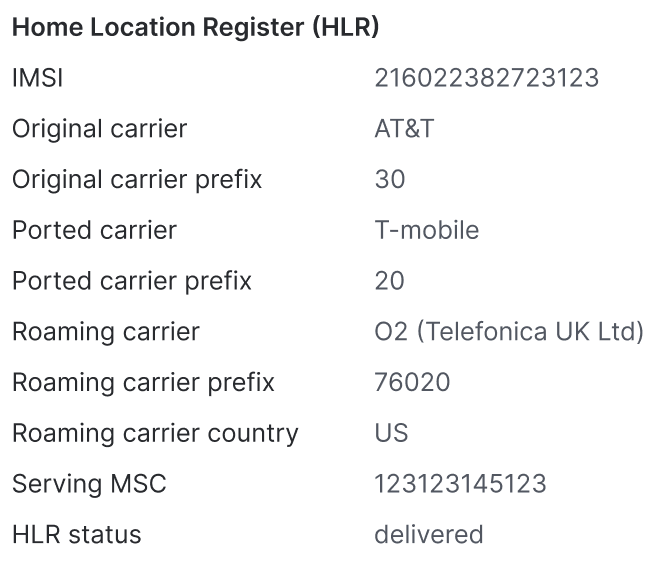
The Home Location Register (HLR) is the GSM network database that holds a live record for every active mobile subscription. An HLR lookup queries that database through a mobile network operator and returns the number's current status, carrier, and roaming state.
A number that is invalid, inactive or sitting on an unexpected roaming carrier is a meaningful signal during onboarding or step-up checks. HLR gives you that information before a transaction clears. HLR results appear in the Home Location Register (HLR) subsection of Telco attributes and are returned in the hlr_details API object:
| Field | Description |
| IMSI | The International Mobile Subscriber Identity tied to the SIM. |
| Original carrier Original carrier prefix | The carrier that originally issued the number. |
| Ported carrier Ported carrier prefix | The carrier currently serving the number, if it has been ported. |
| Roaming carrier Roaming carrier prefix Roaming carrier country | Identifies browsing sessions that show strong indicators of originating from the Devin AI agent. |
| Serving MSC | The Mobile Switching Center currently serving the number, when available. |
| HLR status | The delivery status of the lookup (for example, delivered). |

Check the registered name with CNAM lookup
Caller Name Delivery (CNAM) links a phone number to the name displayed on a recipient's caller ID. SEON's CNAM lookup returns the name registered to a number, which you can compare against the name a customer provided during onboarding or at checkout.
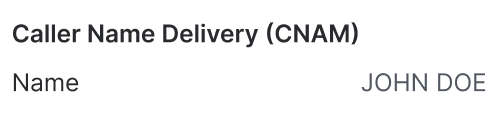
A mismatch between the CNAM value and the customer of record is a supporting signal for impersonation and synthetic identity attempts. Treat it as corroborating evidence alongside other risk signals, not as a standalone determination.
CNAM results appear in the Caller Name Delivery (CNAM) subsection of Telco attributes and are returned in the cnam_details object:
| Field | Description |
| Caller Name Delivery (CNAM) | The name registered to the number. CNAM values are up to 15 uppercase alphanumeric characters. |
Detect recent SIM swaps
A SIM swap moves a phone number onto a new SIM card. Attackers use it to take control of a number, intercept SMS authentication codes and reset account credentials. The swap itself is usually invisible to device signals and digital footprint checks — the number looks exactly the same from the outside.
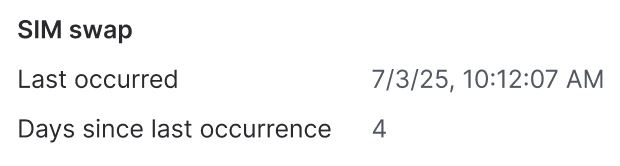
SIM swap detection identifies whether the SIM behind a number was recently replaced and when it happened. The timestamp and days-since value let you act on recency: a swap that occurred four days ago carries a very different risk profile than one from six months ago, and your rules can reflect that.
SIM swap results appear in the SIM swap subsection of Telco attributes and are returned under sim_swap:
| Field | Description |
| Last occurred | The date and time of the last detected SIM swap event. |
| Days since last occurrence | Show the days passed since the last occurred date. |
Review porting history for carrier changes
Phone number porting moves a number from one carrier to another. Fraudsters port numbers to seize control of them, sustain scams, or obscure their identity. A number with multiple recent ports is a meaningful flag; one that has stayed on the same carrier for years reads as lower risk.
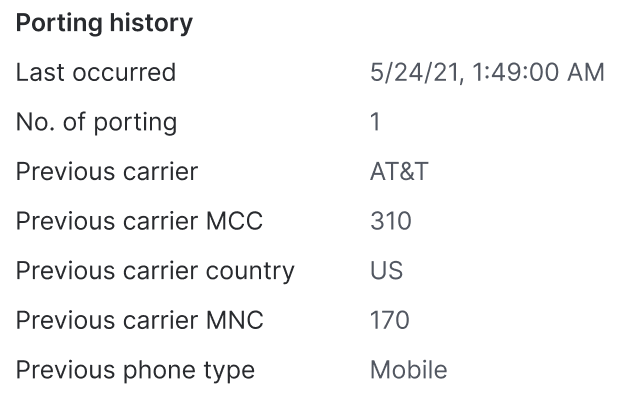
This signal returns whether the number was ported, when it last happened, how many times it has been ported within the lookback window, and details of the previous carrier — useful for phone identity stability checks, synthetic identity detection, and lending and underwriting risk.
Coverage is limited to select countries, and the lookback window varies by market: the US covers the last 90 days, the EU the last 180 days. A porting event outside the window returns no history, even if porting occurred further back.
Results appear in the Porting history subsection of Telco attributes and are returned under porting_history:
| Field | Description |
| Last occurred | The date of the most recent porting event. |
| No. of porting | The number of times the phone number was ported in the last 90 days. |
| Previous carrier | The name of the carrier from which the number was ported. Only supported for US numbers. |
| Previous carrier MCC | The Mobile Country Code (MCC) of the previous carrier. Only supported for US numbers. |
| Previous carrier country | The 2-letter ISO country code of the previous carrier. Only supported for US numbers. |
| Previous carrier MNC | The Mobile Network Code (MNC) of the previous carrier. Only supported for US numbers. |
| Previous phone type | The phone type (e.g., "mobile") associated with the previous carrier. Only supported for US numbers. |
Get more insights with the telco risk score
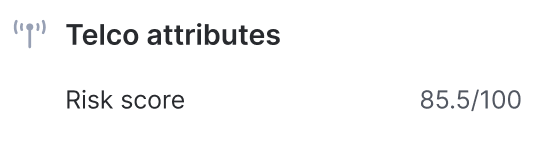
The telco risk score is a machine learning score derived entirely from carrier-level signals. It analyzes patterns associated with a phone number, such as receiving authentication requests from multiple countries in a short period and returns a normalized score between 0 and 100. Higher scores indicate higher risk.
The score appears as Risk score at the top of the Telco attributes section and is returned under telco_risk_score in the API response. Use it as a single numeric input for rules and automated decisions. Combined with other telco signals, it gives your models a layered view of carrier-level risk.
How to request telco signals
HLR & CNAM lookups, SIM swap, porting history and the telco risk score are extensions to the standard Phone API. Once enabled under your account, you can add the relevant values to include inside the config parameter of a Phone API request, or inside the phone config object of a Fraud API request.