


Settings: Fraud API Configuration

Updated on 22.06.26

1 minute to read

Copy link
Overview
SEON’s Fraud API analyzes multiple data points from each order to produce a comprehensive fraud score. You can toggle each verification module on or off to control which checks are performed. Disabling a module means that specific data type won’t be analyzed during the fraud check.
How to configure
- Open the SEON Fraud Prevention app from your Shopify admin.
- Go to Settings.
- Scroll to the Fraud API Configuration Settings section.
- Toggle each module on or off according to your needs.
- Click Save.
Available modules
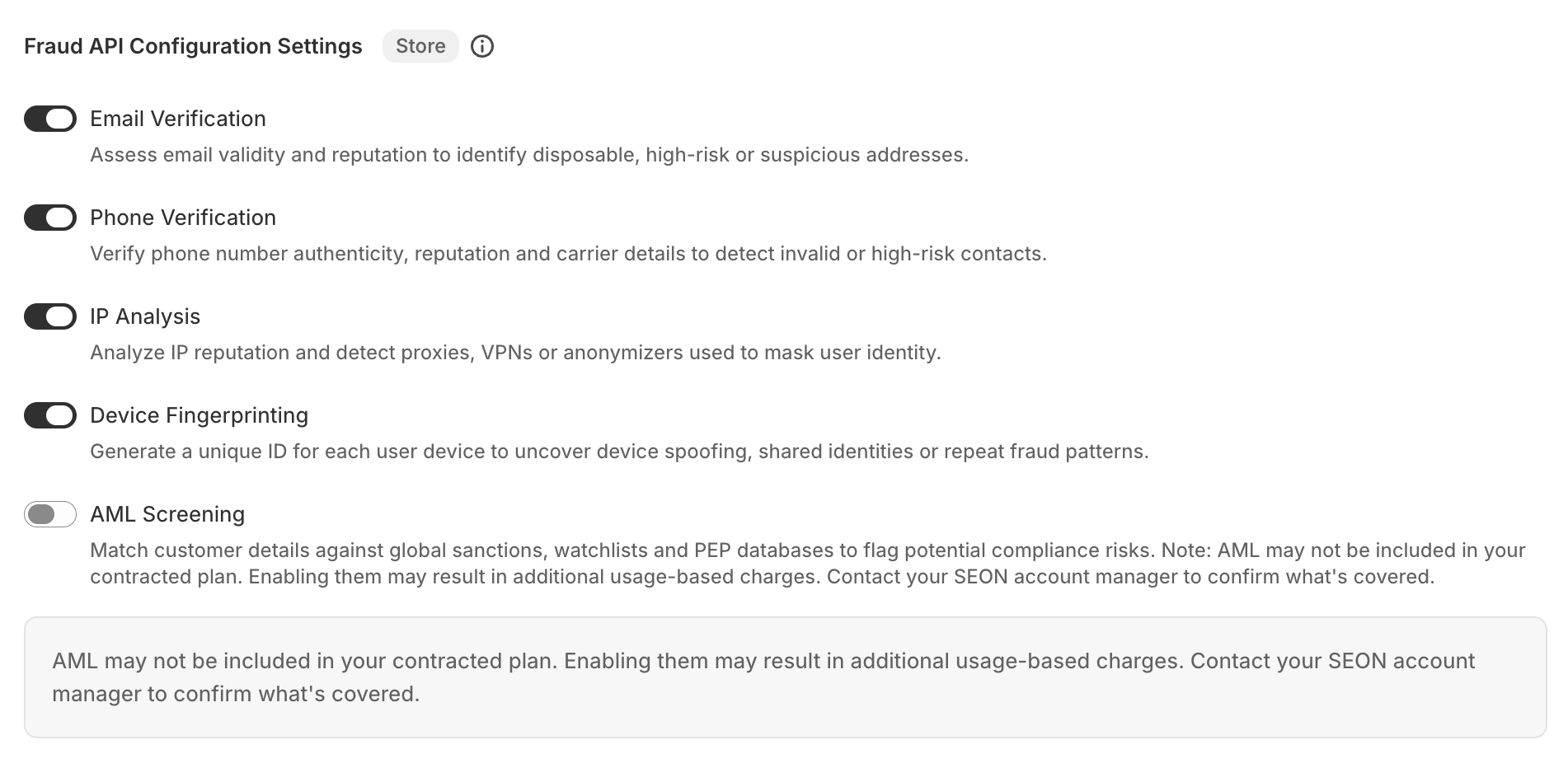
Email verification
What it does: Assesses the validity and reputation of the customer’s email address. Checks email deliverability, domain age, social media presence linked to the email, and known fraud patterns.
Default: On
Phone verification
What it does: Verifies the authenticity of the customer’s phone number. Checks carrier details, phone type (mobile, VoIP, landline), and whether the number is associated with known fraud activity.
Default: On
IP analysis
What it does: Analyzes the customer’s IP address for reputation, geographic location, and suspicious characteristics. Detects the use of proxies, VPNs, TOR networks, and data center IPs.
Default: On
Device fingerprinting
What it does: Generates a unique device identifier based on the customer’s browser and device characteristics. Detects device spoofing, emulators, and identifies returning devices across sessions.
Default: On
AML screening
What it does: Matches customer information against global sanctions lists, politically exposed persons (PEP) lists, and watchlists for anti-money laundering compliance.
Default: Off

Recommendations
- We recommend keeping Email Verification, IP Analysis, and Device Fingerprinting enabled for full fraud coverage.
- Phone Verification adds an extra layer of identity validation but can be disabled if phone numbers are not consistently collected.
- AML Screening is recommended for businesses in regulated industries or those selling high-value goods. Be aware of potential additional charges.